Practical AI that improves a real workflow—measured, contained, and safe.
NVAA helps Central Pennsylvania teams adopt AI without hype, surprise costs, or risky data exposure. We run fixed‑scope, time‑boxed engagements that start with a baseline and end with a clear decision and usable artifacts.
- Baseline first: define “better,” measure it, then improve it.
- Guardrails up front: data handling, limits, approvals, and cost controls documented early.
- Operational handoff: runbooks, training, and ownership—so you’re not dependent on us.
Measured against a defined baseline; results vary by workflow, constraints, and data readiness.
Fixed-scope & time-boxedVendor-neutral toolingSecurity & privacy firstWork directly with the principalLocal: Central PA
Best fit / Not a fit
We make fit explicit to protect outcomes and avoid scope creep.
Best fit if…
- You have a real workflow problem (not a curiosity project).
- You want measurable improvement (baseline + success metric).
- You care about privacy, risk, and predictable cost.
- You can name a process owner for decisions and testing.
Not a fit if…
- You want open-ended R&D.
- You need a full product team or 24/7 support.
- You can’t provide access to the workflow owner or core artifacts.
- You want “AI everywhere” in one engagement.
You won’t get a demo. You’ll get a decision packet.
Our work ends with artifacts your team can use: what changed, what it cost, what it saved, what risks remain, and whether to scale.
Baseline + Success Scorecard
What “better” means, how it’s measured, and results vs baseline.
Guardrails + Data Handling Notes
Where data flows, what’s allowed, what’s blocked, and who approves.
Thin-Slice Working Solution
A production-minded implementation sized to prove value safely.
Runbook + Training
How to operate, monitor, update, and roll out without heroics.
What we refuse to do (on purpose).
Most AI failures are predictable—and preventable. We avoid them by saying “no” early.
- We don’t sell “AI strategy” that never touches the workflow.
- We don’t ship untested prototypes and call them production.
- We don’t automate high-stakes decisions without oversight and documented limits.
- We don’t hide behind vendor promises or “model magic.”
- We don’t run open-ended engagements without scope, gates, and ownership.
If you’re shopping for a demo-only engagement, we’re probably not the right fit.
Three time‑boxed ways to reach a defensible decision.
Start small, prove value, and build capability—one disciplined step at a time.
FRAME
Decide what’s worth proving—and what’s not.
A fixed-scope assessment that turns AI curiosity into a practical roadmap: what to do, what not to do, and what to prove first.
Duration: ≈2–3 weeks
Pricing: $3,000–$5,000 fixed (Light/Standard)
Primary deliverables
- AI Opportunity Map (8–15 use cases)
- Readiness Snapshot
- Risk & Governance Lite
- 30/60/90 Roadmap + Pilot Brief
PROVE
Ship one measurable workflow improvement in 4–8 weeks.
A fixed-fee engagement delivering one workflow improvement with baseline measurement, guardrails, and a clear scale/iterate/retire decision.
Duration: 4 or 8 weeks
Pricing: $15,000 (4-week) or $25,000 (8-week) fixed
Primary deliverables
- Pilot Charter + KPI
- Baseline + Success Scorecard
- Working thin-slice solution
- Decision Packet + ROI estimate
- Runbook + rollout training
EMBED
Train your team to use AI safely—without shadow AI chaos.
Practical, in-person training focused on safe-use habits, workflow patterns, and simple guardrails to improve adoption and reduce risk.
Duration: Half-day or full-day
Pricing: $1,500–$2,500 (half) • $3,000–$5,000 (full)
Primary deliverables
- Live workshop
- Handouts + templates (PDF)
- AI Use Policy Starter (draft)
- Use-case shortlist + 30-day action plan
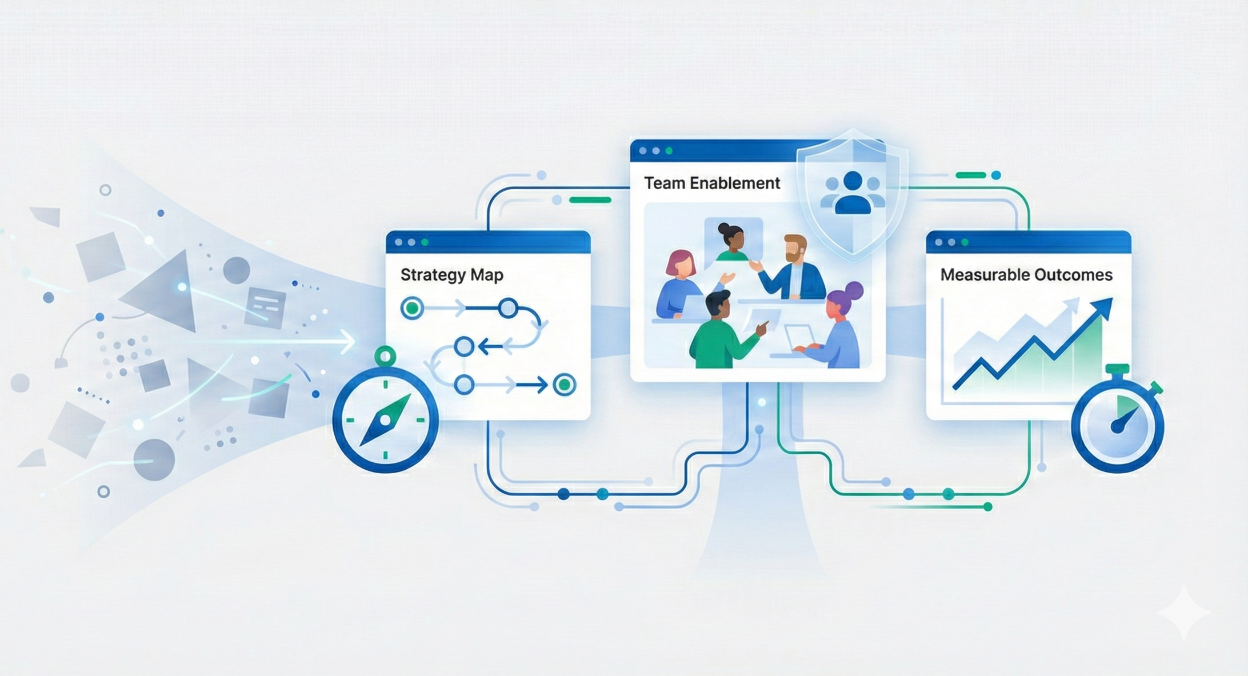
Workflow first. Baseline first. Decision gates that keep things honest.
Frame the workflow, prove value in the real work, then embed ownership so it sticks.
1) Frame
Map the workflow, define “better” in measurable terms, confirm constraints, and write down what must be true to proceed.
2) Prove
Build a thin-slice pilot with guardrails, measure against baseline, and produce a scale/iterate/retire decision packet.
3) Embed
Leave documentation, training, and ownership so the team can operate safely—without long‑term dependency.
FAQs
Straight answers to common questions.
Make the next step small—and defensible.
Start with Training if you need alignment and guardrails fast. Start with the Assessment if you need clarity and a plan leadership can approve.